
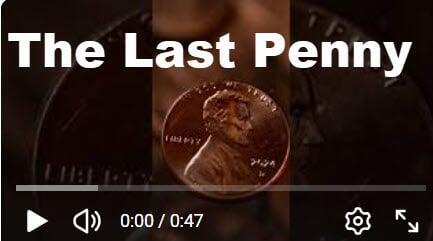
The Last Penny- Government Shut It Down Forever
The End of the Penny
The United States has finally done something people joked about for years: it shut down the penny. The small copper-colored coin has become a symbol of waste, costing more to produce than it is worth and clogging wallets, jars, and junk drawers everywhere.
Recently, the Treasury Secretary even minted the last few pennies as a symbolic farewell. Many Americans looked at the news and thought, “It’s about time.” But behind the nostalgia and the jokes, this change affects how we see prices, pay tax, and think about small amounts of money.
Why the Penny Had to Go
You know inflation is serious when money is worth less than its metal. The penny has clung to life for generations, like a guest who will not leave after the party is over. The lights are off, everyone is tired, and yet the penny stays.
We often think of the penny as a way we honor Abraham Lincoln. But Lincoln deserves better than being the mascot for monetary clutter, rolling in lint at the bottom of a gym bag. He still appears on the $5 bill. The problem is not Lincoln. The problem is the math.
For decades, the penny has been economically dubious. It costs roughly three cents to make one cent. That is bad arithmetic. If a business did that, an accountant would pull them aside and ask if everything is okay. When Washington does it, we sigh and call it tradition.
Ending the penny is a way of admitting the math finally matters.
A Global Perspective: Other Countries Moved First
The United States is not the first country to let go of its smallest coin.
Canada retired its penny years ago. Australia stopped using its one-cent coin long before that. Around the world, governments have looked at the cost of tiny coins and decided they no longer make sense.
Even here at home, the Internal Revenue Service (IRS) has long told taxpayers to round amounts to the nearest dollar on certain forms. In other words, the federal tax system has already been comfortable ignoring pennies in many places. The culture just had to catch up.
The U.S. penny hung on for emotional reasons more than economic ones.
How Losing the Penny Changes Prices and Sales Tax
Eliminating the penny will not just lighten your pockets. It changes how we think about prices and sales tax.
For years, businesses have used the $9.99 price game. Your brain knows it is basically $10. But seeing the 9 at the front makes it feel cheaper. Retailers cling to that one-cent illusion because it nudges you emotionally.
Without pennies, the game gets harder to play. That $9.99 price becomes $10 when we round to the nearest nickel. Your inner voice no longer whispers, “It’s still nine-something.” It now says, “That is ten dollars.”
Sales tax also changes in small ways. Many states use odd percentage rates that create decimals when you calculate tax. Right now, pennies clean up those decimals. Without pennies, cash totals will be rounded to the nearest nickel instead. Overall, that shift is not a big deal for most people, unless you enjoy reading long, complicated receipts.
The bigger impact is mental. It makes prices feel more honest and forces everyone to see round numbers more often.
Digital Payments and Quiet Rounding
The end of the penny nudges everyone a little more toward digital payments.
When you tap a card or use a phone, the math happens in the background. Rounding is handled quietly by the system. Your brain does not have to chase decimals or think about whether you got two pennies back or three.
In a country where many people are still unbanked, this raises fair questions about access and fairness. But there is also an upside: the shift pushes all of us to pay attention to how small amounts move in and out of our accounts.
As coins matter less, numbers on a screen matter more.
Small Amounts, Big Impact on Your Money Habits
Ending the penny is not just a story about a coin. It is a reminder about how small changes add up.
Taxes, prices, interest, and costs move upward in tiny increments. A fee here. A slightly higher rate there. One percent more or less on a bill or a savings account. Each change looks small on its own, but they add up to real dollars over time.
The penny teaches a simple lesson: not all small things matter equally.
A single cent means almost nothing by itself. But your tax habits, retirement contributions, charitable giving, and investment decisions rise or fall on small percentages. Ignore those percentages and you lose dollars. Pay attention to them and you gain dollars.
The phase-out of the penny is a good moment to ask yourself:
- Do I know where the “small leaks” are in my finances?
- Am I letting tiny, recurring costs pile up?
- Have I set small but steady contributions toward savings or retirement?
Financial life runs on details, not on coin denominations.
From One Copper Coin to Your Real Tax Bill
If a single copper coin can inspire national debate, imagine what intentional planning can do for your actual tax bill.
We can shrug at small change. But we should not shrug at small percentages on our tax returns, our payroll withholding, or the way we structure our business income. That is where real money lives.
If you want one last sentimental moment with the penny, toss one into a fountain and make a wish that helps you keep more of your money. Let the penny remind you that tiny amounts can add up when someone is paying attention.
Then turn that wish into a plan.
FAQ: Common Questions About the Penny Phase-Out
Q: What does it mean that the penny is being phased out?
A: Phasing out the penny means the government has stopped producing new pennies and is moving the system toward prices and payments that no longer need them. Existing pennies may still circulate for a while, but over time they will become less common. The goal is to reduce waste and simplify transactions.
Q: Will getting rid of the penny raise my taxes?
A: The penny phase-out does not change tax rates by itself. What changes is how totals are rounded in some payments, especially cash transactions. The real risk for taxpayers is not the loss of a coin, but ignoring the small percentage changes in tax rules and personal habits that add up over time.
Q: How will prices like $9.99 work without pennies?
A: Without pennies, prices that end in 1, 2, 3, or 4 cents will round down or up to the nearest nickel, and prices that end in 6, 7, 8, or 9 cents will do the same. Many $9.99 style prices will effectively become $10 when rounding is applied. This makes pricing feel more honest and can change how shoppers react to listed prices.
Q: Does the penny phase-out affect digital payments differently from cash?
A: Digital payments handle rounding behind the scenes, so you may not notice much change when you pay by card or phone. The system quietly applies the rounding rules while showing you a clear total. The main difference is mental: you see fewer tiny coin amounts and more clean numbers on your receipts and statements.
Q: Why does the end of the penny matter for my overall financial life?
A: The penny itself is small, but it highlights a larger truth: small amounts and small percentages can add up to big results. Paying attention to “little” details in taxes, interest rates, and everyday costs can help you stop overpaying and start keeping more of what you earn. The phase-out is a good reminder to review your habits and your plan.
If you want help using these rules and habits so you stop overpaying tax and can buy more of the stuff you love, contact Anvil Tax to schedule a strategy call. David Tuck, former IRS auditor and founder of Anvil Tax, can help you turn small financial details into real, long-term savings. Visit www.anviltax.com to get started.